
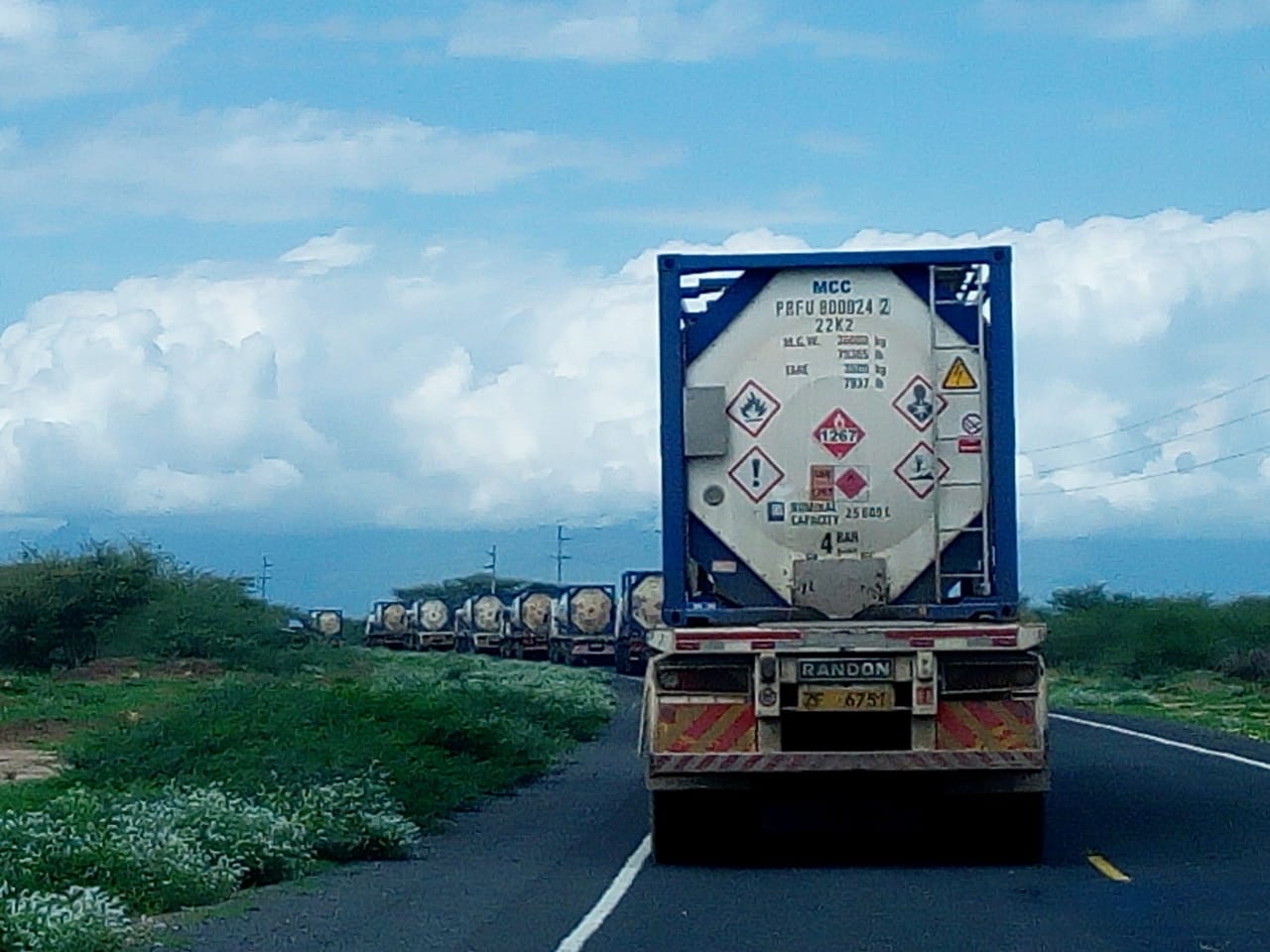

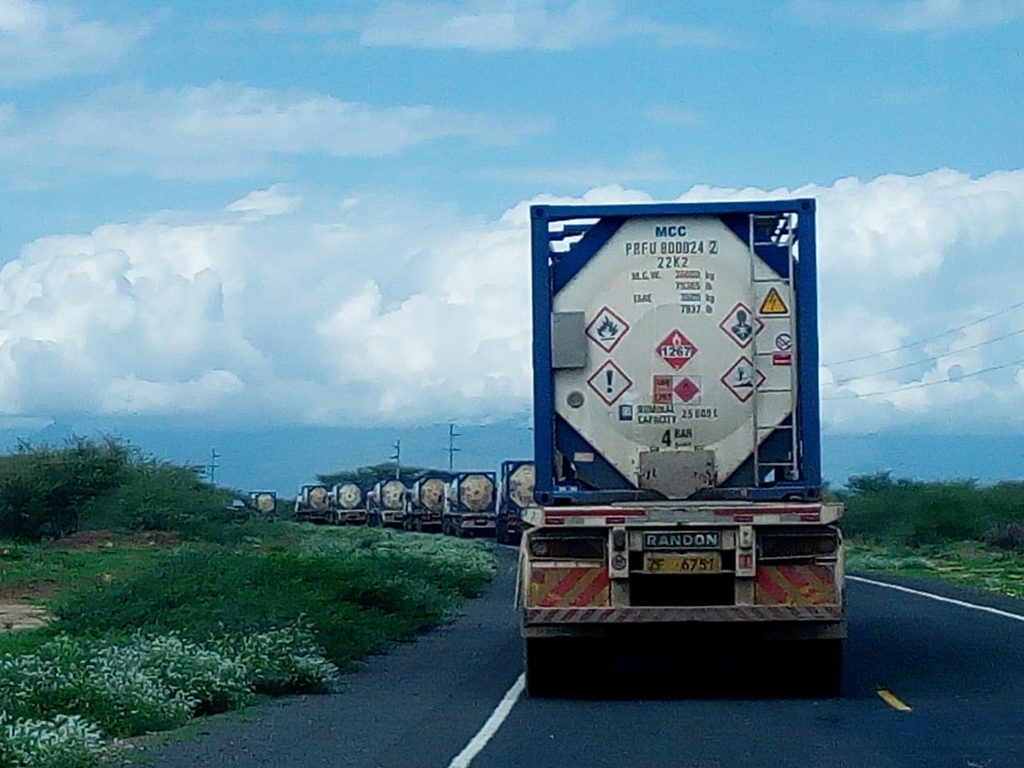
Hazardous materials transportation on Kenya’s Northern Corridor carries risks that standard freight protocols were never built to manage. What the road demands – and what responsible operators owe the communities they drive through.
Hazmat & Safety18 July 20267 min read
There is a plaque by the roadside at Sachangwan. One hundred and thirty names are engraved on it. Seventy-eight of those people are buried directly behind it – not in a cemetery, not in a church compound – in a mass grave, by the road. Because the fire came so fast and burned so completely that nobody could tell who was who.
January 31, 2009. A fuel tanker carrying 50,000 litres of unleaded petrol overturned on the Nakuru-Eldoret highway. It was headed for Juba. It never arrived.
And here is the thing about a hazardous materials incident that a regular truck accident does not teach you – it does not end at the point of impact. The cargo keeps going. As fire. As chemical contamination. As airborne toxins. As fuel moving with gravity toward everything the road runs through. The radius of a hazmat incident is not measured in metres. It is measured in the reach of what was inside the vehicle.
That tanker lay on its side for two hours while residents came from the trading centre with jerricans. Then it ignited. One hundred and thirty people were gone. The cargo did not distinguish between the driver, the bystanders, and the families who lived closest to that stretch of road.
Kenya’s single worst hazardous materials road incident. 78 victims were buried in a mass grave at the roadside.
The community is still healing.
Our route passes through that stretch. Our drivers know that plaque. Some of them have slowed down to read it.
What Makes Hazmat Transportation Categorically Different
Hazardous materials transportation in Kenya – and across East Africa’s Northern Corridor – is not simply freight with additional paperwork. It is a fundamentally different category of risk, where the cargo itself is the primary hazard once containment is lost.
Under international ADR classifications and Kenya’s dangerous goods regulatory framework, hazardous materials fall into nine distinct classes, each with its own emergency response protocol, containment requirement, and liability chain:
Class 1
Explosives
Class 2
Gases (compressed, liquefied, dissolved)
Class 3
Flammable liquids – including petroleum products
Class 4
Flammable solids
Class 5
Oxidising substances & organic peroxides
Class 6
Toxic & infectious substances
Class 7
Radioactive material
Class 8
Corrosive substances
Class 9
Miscellaneous dangerous goods
The Northern Corridor carries every one of these classifications regularly. Petroleum products out of Mombasa. Industrial chemicals moving toward inland manufacturing. Compressed gases. Agricultural chemicals. Corrosives bound for construction projects in Uganda and beyond. At any given moment, dozens of hazmat loads are moving along the Nairobi-Nakuru-Eldoret-Malaba stretch simultaneously.
“A regular truck accident ends at the point of impact. A hazardous materials incident does not. The radius is not measured in metres – it is measured in the reach of what was inside the vehicle.”
The Northern Corridor’s Hazmat Risk Landscape
The Northern Corridor is Kenya’s most economically critical freight route – and one of its most dangerous. It connects the port of Mombasa to Nairobi, through the Rift Valley, past Nakuru and Eldoret, and on through Malaba to Uganda and into the wider East African hinterland. The road carries approximately 80% of East Africa’s landlocked freight.
It also carries a documented history of catastrophic hazmat incidents.
Salgaa and Sachangwan: The Corridor’s Most Dangerous Stretch
The Salgaa-Sachangwan stretch on the Nakuru-Eldoret highway is widely regarded as Kenya’s most dangerous road corridor. The gradient, traffic density, and concentration of heavy freight vehicles create conditions where incidents are not rare. They are recurring.
- January 2009: Sachangwan fuel tanker fire – 130 lives lost
- August 2024: Seven people killed after a bus lost control near Salgaa-Migaa
- March 2025: Twelve lives lost in a trailer-matatu collision near Migaa
- December 2025: Five-vehicle pileup at Sachangwan – suspected mechanical failure, multiple fatalities
- August 2026: Multi-vehicle crash at Salgaa, truck driver killed at the scene
This is not a black spot in the historical sense. It is an active, ongoing risk zone through which hazardous materials pass every single day.
Mai Mahiu and the Escarpment Descent
The descent from Naivasha to Mai Mahiu – where OML Africa Logistics operates its logistics centre – presents a distinct hazmat risk profile. The steep gradient, combined with the weight of fully loaded tankers and chemical carriers, creates significant brake-stress conditions. A vehicle that loses brake integrity on the Naivasha escarpment with a hazmat load is not a freight incident. It is a community emergency.
They made no transport decision. They bear the consequence.
The Regulatory Framework: What ADR 2026 Demands
Hazardous materials transportation in Kenya operates under a layered regulatory framework – the Kenya Roads Act, NTSA enforcement requirements, KEBS standards for dangerous goods, and NEMA environmental compliance obligations. Internationally, the ADR framework sets the benchmark that cross-border logistics firms operating on the Northern Corridor are increasingly expected to meet.
In 2026, ADR regulations underwent a significant structural shift. The framework has moved to a fully digital-first model:
- Mandatory digital documentation replacing paper-based hazmat records
- e-CMR (electronic consignment notes) for cross-border dangerous goods
- Strict cross-referencing between ADR hazmat logs and driver tachograph/activity records
- Updated classification for lithium battery waste under Class 9
- Enhanced Instructions in Writing, digitally issued and driver-acknowledged before departure
The compliance bar has moved. Operators whose documentation systems have not moved with it are carrying legal exposure they may not yet have quantified.
What Responsible Hazmat Transport Looks Like in Practice
The liability of a logistics firm in a hazmat road incident in Kenya extends far beyond the vehicle and the cargo. Environmental contamination, community displacement, emergency response costs, and criminal prosecution for regulatory non-compliance can follow a single incident for years.
The question is not whether the load is insured. It is whether the entire operational framework around that load is built to prevent, contain, and respond.
Responsible hazmat transport on the Northern Corridor combines the following:
- ADR-compliant digital documentation and real-time record-keeping
- Driver certification in hazardous goods handling – not just general freight
- Vehicle certification: fire suppression systems, spill containment kits, approved tanks, safety valves
- Pre-trip route risk assessments identifying gradient points, black spots, and emergency response access
- Emergency response protocols that exist before the incident – not written after it
- Community impact awareness – knowing what lies alongside the route the hazmat load travels
- Real-time GPS monitoring with geofence alerts for deviation from approved hazmat corridors
The firms with the strongest hazmat safety records build one additional layer that no regulation mandates: a safety culture where drivers can flag concerns – about the vehicle, the load, the route, or their own condition – without fear of losing the trip.
In direct and indirect losses, before legal proceedings. In a hazmat incident with community impact, that figure compounds significantly.
What This Road Demands from Every Operator on It
OML Africa Logistics operates on the Northern Corridor. We are not observing these risks from a distance – we move through Salgaa, through Sachangwan, down the Mai Mahiu descent, through Malaba. Our drivers pass that plaque. Some of them have read the names.
That proximity is not something we treat as background information. It is the reason we hold hazmat transportation to a standard that goes beyond compliance – because the communities along this corridor are not abstractions in a risk assessment. They are the people nearest the road when something goes wrong, and they had no say in the transport decision that brought that load through their trading centre.
That weight belongs to every firm operating on this corridor. We carry it seriously. Every trip. Every load. Every kilometre between here and the border.
Frequently Asked Questions
Common questions about hazardous materials transportation in Kenya and across East Africa’s Northern Corridor.
What are the regulations for transporting hazardous materials in Kenya?
Hazardous materials transportation in Kenya is governed by the Kenya Roads Act, NTSA enforcement requirements, KEBS standards for dangerous goods, and NEMA environmental compliance obligations. In practice, cross-border logistics firms on the Northern Corridor increasingly operate under the ADR framework.
What caused the Sachangwan tanker disaster in 2009?
On January 31, 2009, a fuel tanker carrying 50,000 litres of unleaded petrol overturned at Sachangwan on the Nakuru-Eldoret highway. The tanker lay on its side for approximately two hours while residents gathered to siphon the spilled fuel. It then ignited, killing at least 130 people. Seventy-eight victims were buried in a mass grave at the roadside.
What is ADR compliance and does it apply to logistics firms in East Africa?
ADR is the European Agreement concerning the International Carriage of Dangerous Goods by Road – the international standard for hazmat transport by road. ADR-aligned frameworks are increasingly adopted by East African logistics firms operating cross-border or serving international clients.
What are the most dangerous stretches for hazmat transport on the Northern Corridor?
The most documented high-risk stretches include the Salgaa-Sachangwan corridor on the Nakuru-Eldoret highway, the Mai Mahiu escarpment descent, and the Naivasha gradient. The Malaba border crossing presents additional risk due to extended dwell times for stationary hazmat loads.
What is the liability of a logistics firm in a hazmat road accident in Kenya?
A logistics firm’s liability in a hazmat road incident extends well beyond the vehicle and cargo. It can include third-party personal injury and fatality claims, environmental contamination and remediation costs, community displacement compensation, regulatory penalties, and criminal prosecution for negligence.
How do logistics firms manage hazmat risks on the Northern Corridor?
Responsible operators combine compliant documentation, certified driver training, vehicle certification including fire suppression and spill containment, pre-trip route risk assessments, real-time GPS monitoring with geofence deviation alerts, and documented emergency response protocols.
We Operate on This Corridor. We Take It Seriously.
OML Africa Logistics is a 100% Kenyan-owned heavy haulage and freight company operating along the Northern Corridor – from Mombasa through Nairobi, Eldoret, and Malaba into Uganda and beyond.
Safety, compliance, and community responsibility are built into how we operate, not bolted on after the fact.
#HazmatTransport #NorthernCorridor #ADR2026 #LogisticsKenya #FreightSafety #EastAfricaLogistics