

Before the world sees production charts rise, before the headlines speak of first oil, and long before tankers pull away from terminals, something remarkable begins to unfold, quietly, in the far corners of the land.
It starts with uncertainty. A stretch of ground, vast and unmarked, known more for silence than potential. Geologists walk it. Drones scan it. Seismic trucks send waves into the earth and wait for echoes. Every step, every signal, holds a possibility: there might be oil below. And then, there is a decision – to drill. One well. A wildcat. A single test of faith and science. The rig goes up. Crews gather. Equipment arrives from all directions. It’s a moment suspended between hope and economics. And when that first test brings oil to surface, everything changes.
Suddenly, the land is no longer empty. It becomes a project. A plan. A promise. What follows is a quiet storm of coordination. Roads must be built, not highways, but access routes strong enough to carry cranes, rigs, and 80-ton separators. The terrain doesn’t wait for permission. It floods, it breaks, it resists. But the work continues.
Camps rise from container units. Water and power are trucked in. Everything begins to move. Then the real building begins. Well pads are carved into the earth, lined with gravel, prepped to host the machines that will reach deep into the reservoir. Alongside them, the central processing facility starts to take shape, the heartbeat of the field, where oil will be treated, measured, and sent on its way.
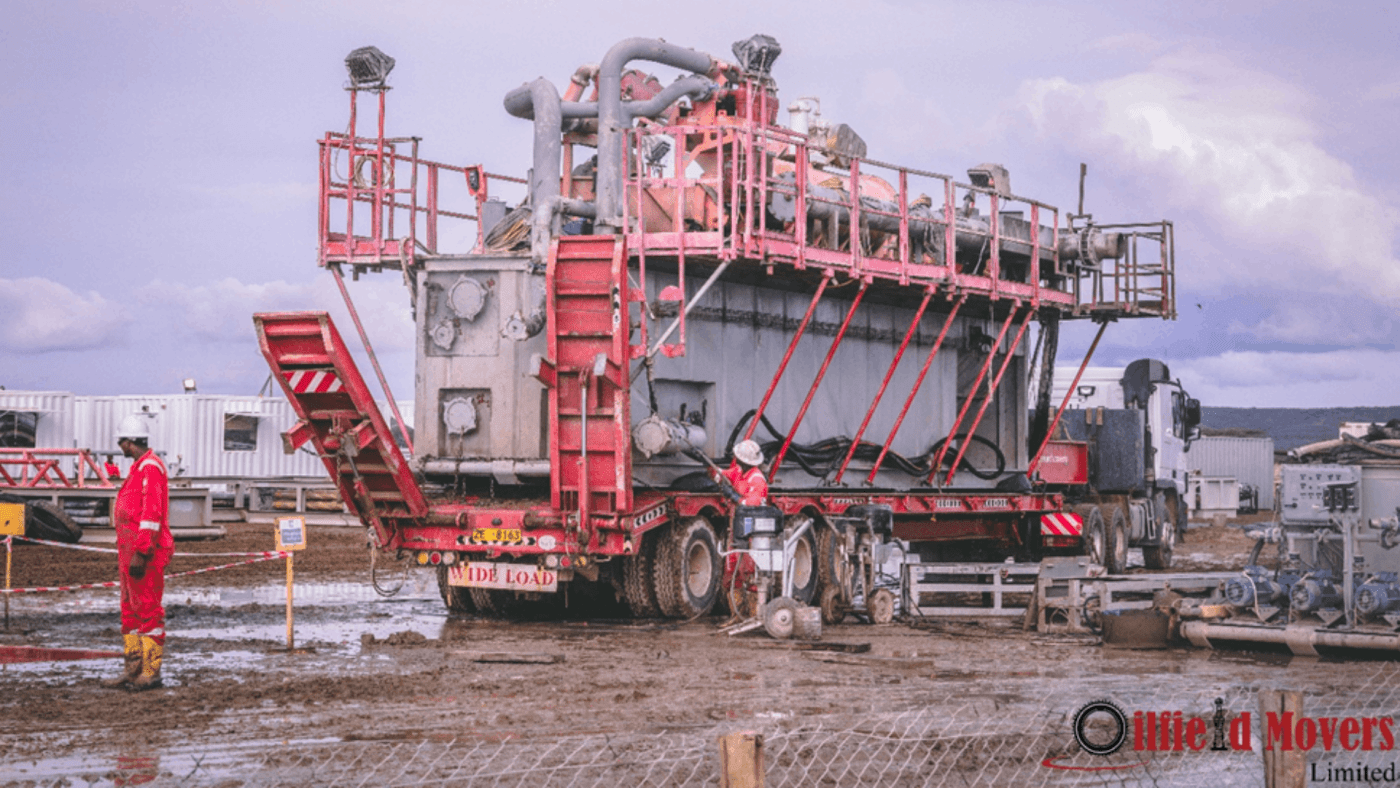
Convoys arrive daily. Long, wide, slow-moving giants carrying prefabricated modules, flare stacks, transformer units. Every delivery is a negotiation with time and distance. Drivers navigate narrow bridges, washed-out tracks, and communities that are learning, slowly, what’s being built beside them. The drilling phase begins in earnest. Not just one well now, but many. Vertical. Directional. Some for production, others for injecting water back into the reservoir to keep pressure balanced. The site becomes alive with motion. Trucks arrive with drill pipe and casing. Chemical tanks are offloaded in designated zones. Crews rotate, equipment is swapped, and behind it all is the rhythm of logistics; consistent, invisible, essential.
Soon, the first oil flows through the system. It enters the separators, leaving water and gas behind. The crude moves forward, cleaner, measured by meters, stored in tanks, and eventually shipped to the world. But this is not the end, it’s only the beginning of life as a working oilfield. From this point, operations must be sustained. The field now requires a new kind of movement, steady, predictable, and unrelenting. Spare parts, filters, lubricants, safety gear, food supplies. Fuel for generators. Water for camps. Personnel rotations. Emergency spares flown in at odd hours. There’s no slowing down. No detail too small. If logistics falters, the field stumbles.
Over time, focus shifts. How do we produce more with fewer emissions? Can we switch to electric pumps? Can waste be reduced? Communities expect more. So do regulators. The supply chain evolves, not only to serve the operation, but to align with the world’s new priorities: efficiency, transparency, and sustainability. And when the oil no longer flows the way it once did, the final phase begins, decommissioning. Carefully, respectfully, the field is dismantled. Equipment is removed, roads are restored, and land is cleaned. The logistics that once built it now carries it away, piece by piece, leaving behind not a void, but a legacy.
This is how an oilfield comes together. Not just through drilling and technology, but through strategy, movement, timing, and trust. It is built by people who understand not just where to go, but how to get everything there. Safely. On time. Every time. Behind every barrel, there’s a journey. And behind that journey, there’s a logistics story worth telling.